By Coach Phil | Feel Fitness
Let me ask you a question.
You have time for board meetings, client presentations, business lunches, WhatsApp groups, traffic jams, and even scrolling through videos of people doing absolutely nothing. But when I ask whether you exercised today, suddenly your calendar looks like the President’s itinerary!
“Coach, you don’t understand. My schedule is crazy!”
Oh, I understand perfectly. I have coached busy executives, entrepreneurs, parents, and professionals for over two decades. Some manage companies with hundreds of employees. Others juggle businesses, family responsibilities, church commitments, and everything in between. And somewhere in that madness, their health quietly takes a back seat.
The Old Fitness Mentality
The old fitness mentality told us to train harder, longer, and more frequently. Miss a workout? Feel guilty. Don’t sweat enough? You haven’t worked hard enough. Didn’t burn 500 calories? What were you even doing at the gym? Taking selfies?
Somewhere along the way, we turned exercise into a punishment rather than a celebration of what our bodies can do. We started measuring progress by how exhausted we felt, how sore our muscles were, and how many calories flashed on a smartwatch. Apparently, if you can still walk comfortably after leg day, you didn’t train hard enough!
Over the years in the fitness industry, I have clearly come to understand : More is not always better, and harder is not always smarter.
We are training to live longer, move better, think clearly, manage stress, remain independent, and enjoy the fruits of our hard work. What good is a six-pack if you are constantly exhausted, nursing injuries, or too tired to enjoy life?
Oh! Unless you are preparing for the Olympics, you really don’t have to push your body to its limits at every single session. Even Olympic athletes understand the importance of recovery!
Fitness should add life to your years, not leave you feeling like you need three business days to recover from every workout!
So, allow me to challenge five fitness habits that might actually be holding you back. Some of them may surprise you, and a few might even offend your gym instructor. But don’t worry, we are here to learn, not to fight!
1. The One-Hour Workout Obsession: Who Made That Rule?
“Coach, I only had 25 minutes, so I skipped the gym.”
Wait a minute! You had 25 minutes to exercise, but because you couldn’t exercise for 60 minutes, you decided to exercise for ZERO minutes? Even mwalimu wa Maths (our Kenyan mathematics teacher) would struggle with that calculation! Somewhere along the way, we convinced ourselves that a workout only counts if it lasts an hour. Says who?
Your body doesn’t carry a stopwatch that refuses to recognize physical activity before the 60-minute mark. A brisk 20-minute walk during lunch, a 15-minute strength routine before breakfast, or a 30-minute cycling session after work can contribute meaningfully to your health.
The World Health Organization recommends that adults accumulate at least 150 to 300 minutes of moderate-intensity aerobic activity weekly, alongside muscle-strengthening activities on at least two days.
Notice the word weekly. You can distribute that activity across your schedule.
Try this:
- Monday: 30-minute brisk walk.
- Tuesday: 20-minute strength workout.
- Wednesday: 30-minute cycling session.
- Thursday: 30-minute brisk walk.
- Friday: 20-minute strength workout.
- Saturday: 60-minute family walk or hike.
That’s 150 minutes of aerobic activity plus two strength sessions, assuming your walks and cycling meet moderate-intensity levels. And yes, walking around the mall counts if you’re actually walking briskly. Moving slowly from one shop to another while sampling snacks is another discussion altogether!
Coach Phil’s takeaway: A shorter workout beats the perfect workout you never did.
2. Waiting for Motivation? You Might Grow Old on That Bench!
This one deserves a whole sermon.
“Coach, I am waiting to feel motivated.”
My friend, motivation is like Nairobi weather. One minute the sun is shining, the next minute you are looking for an umbrella. If you depend entirely on motivation, your exercise routine will become a seasonal event.

January, you are unstoppable. February, you’re negotiating. March, your gym shoes have become household decorations. By April, your gym bag is storing old receipts and phone chargers! I have coached people long enough to know that consistency rarely comes from waking up excited about exercise every day. It comes from creating habits that work even when enthusiasm disappears.
This is why I encourage busy professionals to establish a 15-minute minimum workout. On difficult days, do something manageable.
For example:
- 3 minutes of marching or brisk walking.
- 3 minutes of chair squats.
- 3 minutes of wall push-ups.
- 3 minutes of alternating step-ups.
- 3 minutes of mobility and stretching.
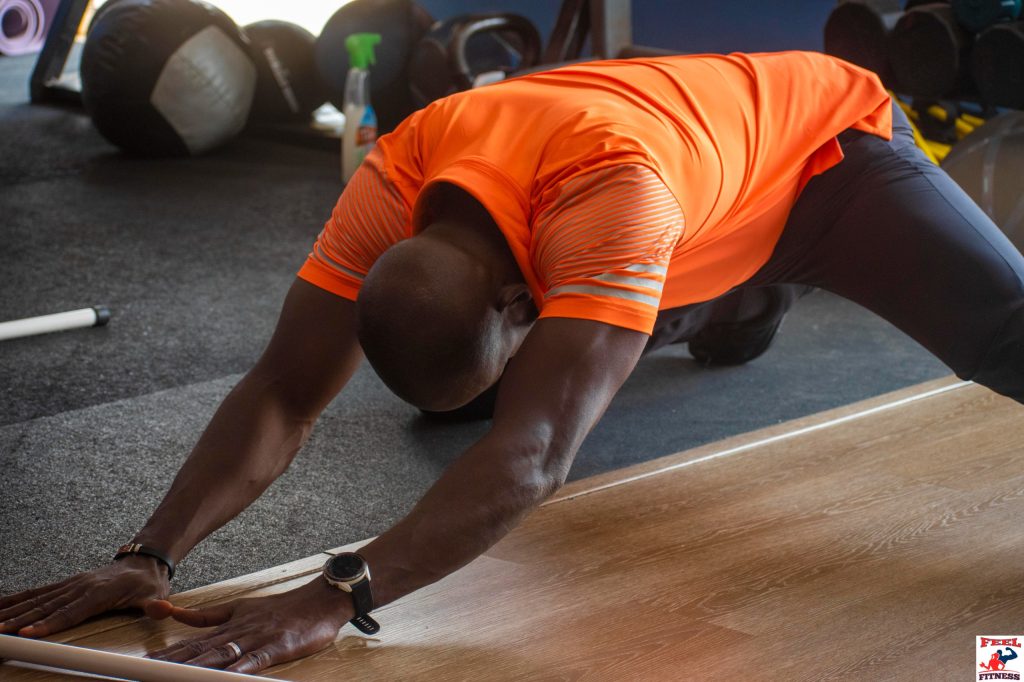
Adjust the movements to your fitness level and physical abilities. Fifteen minutes won’t replace every component of a complete fitness program, but it can help maintain your exercise habit. Some days, you will do more. Other days, 15 minutes will be your victory. And that is perfectly fine. It is also perfect to have 2 or 3 bouts of 15 minutes sessions spread through the day.
Coach Phil’s takeaway: Motivation may get you started, but discipline and realistic routines keep you moving.
3. Stop Worshipping the Calorie Counter!
I have seen people finish a perfectly good workout, look at their smartwatch, and immediately become disappointed.
“Coach, I only burned 280 calories!”
ONLY?
What were you expecting? To burn the entire Christmas buffet in one session?
We have become so obsessed with calorie expenditure that we sometimes forget why we exercise in the first place. Yes, exercise contributes to energy expenditure and weight management. But fitness is much bigger than the number displayed on your treadmill. Can you climb stairs without struggling?, carry your shopping bags without asking the security guard for reinforcement?, lift your grandchild comfortably?, get off the floor without first consulting the furniture? or can you enjoy a hike without needing three people to push you up the hill? Now we are talking about useful fitness!
Strength training helps us build and maintain muscle, improve functional capacity, support bone health, and preserve physical independence as we age. I particularly emphasize strength training when coaching older adults. Because one day, the most important weight you lift may not be a dumbbell. It might be your own body as you rise from a chair.
Coach Phil-Feel Fitness Center
Try this:
Include strength exercises at least twice weekly, targeting your major muscle groups. Depending on your ability and experience, you can use squats, modified push-ups, resistance-band rows, lunges, and other suitable exercises. And please remember that fitness trackers estimate calories burned. They do not provide perfectly accurate measurements.
Coach Phil’s takeaway: Don’t just train to burn calories. Train to build a body that serves you well throughout life.
4. You Cannot Exercise for 45 Minutes and Then Become Office Furniture!
This one is particularly very close to my heart. Some executives proudly tell me:
“Coach, I worked out this morning!”
Excellent!
They begin by sitting in traffic for an hour, then proceed to sit through five hours of meetings. After which, they sit down for lunch before returning to their desks for another three hours. As if that isn’t enough, they sit in traffic again on their way home, only to collapse onto the sofa to recover from what must have been an exhausting day of… well, sitting! My friend, are you a human being or a sofa ambassador?
While one workout is certainly beneficial, it does not, however, completely cancel out the health risks associated with prolonged sedentary behaviour. Our bodies were designed to move regularly. Yet modern workplaces encourage us to remain seated for hours. We have remote controls, elevators, online shopping, food delivery, and colleagues who will bring documents to our desks. Soon, we might need an app to remind us to blink! The solution isn’t necessarily another gym session.
Break Up Your Sitting Time
Walk while taking appropriate phone calls. Use the stairs. Stand up between meetings. Walk to a colleague’s desk instead of sending another email. After lunch, take a 10-minute walk. It can support post-meal blood glucose management and help you feel refreshed. If your work allows, set a reminder to stand and move every 30 to 60 minutes. This is a practical habit, not a magical medical threshold.
I often tell clients that exercise should not be an isolated appointment. Movement should become part of your lifestyle. And no, walking to the fridge every 20 minutes to check whether the cake is still there does not qualify as a serious fitness strategy!
Coach Phil’s takeaway: Your morning workout matters, but what you do with the remaining hours matters too.
5. Your Smartwatch Is Smart, but It Is Not Your Doctor!
Technology has transformed how we monitor exercise. Today, watches estimate heart rate, sleep duration, recovery, training load, and heart rate variability (HRV). Some devices even give you a readiness score. Wonderful tools! But I have noticed something interesting. People are beginning to trust their watches more than their own bodies.
“Coach, my watch says I recovered well.” Fantastic. But how do you actually feel?
“Terrible. I barely slept, and my legs are painful.”
Then why are we preparing for a personal record? Because the watch said so? My friend, even your phone occasionally freezes and needs restarting!
Heart rate variability can provide useful information about physiological stress and recovery patterns. However, one reading cannot tell the complete story. Sleep, fatigue, illness, emotional stress, nutrition, and recent training all influence readiness. Wearable measurements also have limitations, use your fitness watch only as a guide, not as the supreme commander of your body.
Try this: Combine your device readings with a simple daily self-assessment.
Ask yourself:
- Did I sleep adequately?
- Do I feel unusually tired or sore?
- How has my recent training performance been?
- Am I experiencing unusual stress or symptoms?
Look for patterns over time instead of panicking over one number. And if you experience concerning symptoms, seek appropriate medical advice rather than relying on your watch to diagnose the problem.
Coach Phil’s takeaway: Technology should support good judgment, not replace it.
Fitness should SUPPORT your success, not COMPETE with it
Coach PHIL-EXERCISE AND SPORTS SCIENTIST
Over the years, I have watched people build successful careers, establish businesses, raise families, and accumulate wealth. But I have also watched some of them sacrifice their health while pursuing those achievements. They have time to service their vehicles but postpone medical checkups. They invest in property but neglect their muscles.
DON’T BECOME THE RICHEST PERSON IN THE HOSPITAL!
I say this with love and a little humour.
What is the point of building a beautiful retirement home if you cannot comfortably climb its staircase? What is the point of buying a powerful four-wheel-drive vehicle if your knees cannot support a short nature walk? And what is the point of saving for that dream holiday if your physical fitness prevents you from enjoying the activities you worked so hard to afford?
Success should give you opportunities to enjoy life. Your health helps you take advantage of those opportunities. So, stop waiting for the perfect schedule. Stop punishing yourself with unrealistic workouts, measuring every session by calories burned, and allowing your office chair to become your closest companion. And please, stop waiting for motivation to send you an official invitation!
Start where you are. Use what you have. Move consistently. Build strength. Recover well. Because ultimately, fitness isn’t about how much punishment your body can endure. It is about how much life your body can help you enjoy. And if you are still waiting for the perfect Monday to begin exercising, I have some news for you. Monday has been coming every week since you were born. What exactly are you waiting for?